Sage Intacct Implementation in Australia: What to Expect and How to Prepare
Most Sage Intacct projects in Australia don’t struggle because of the software. They struggle because the organisation didn’t prepare its data, its people, or its processes before the project started.
Sage Intacct Implementation in Australia involves more than installing software and copying across old reports. It touches your chart of accounts, your BAS and GST setup, your banking connections, and the way your Finance team works every month. Getting this right from the start makes a real difference to how quickly you get value from the system.
This article explains what Finance Managers and Heads of Finance can expect from a Sage Intacct implementation project in Australia, and how to prepare so the transition is smoother and the system works the way your organisation actually needs it to.
Key Takeaways
- Sage Intacct implementations in Australia are delivered through certified partners, not as a self-service setup, so partner selection matters as much as the software itself.
- Australian-specific requirements, including BAS, GST and local banking, need to be configured correctly from day one, not fixed later.
- New releases such as 2026 R2 and R3 bring automation and reporting improvements that new projects should factor into their design.
- Preparation before the project starts, particularly around data and chart of accounts decisions, has more influence on project success than almost anything that happens during the build.
- Go-live is the start of getting value from Sage Intacct, not the end of the project.
Why Sage Intacct Implementation in Australia Looks Different From Other Markets
Sage Intacct is a global platform, but every implementation needs to reflect local tax, reporting and banking rules. For Australian organisations, this means your project has to account for things that simply don’t exist in a US or UK configuration.
Tax and BAS setup. Your Business Activity Statement reporting, GST codes and ATO-aligned tax tracking need to be built correctly into the chart of accounts and tax groups from the start. Getting this wrong early on usually means rework later, often during a period when your team is already stretched trying to close the books on the new system for the first time.
Banking connections. Australian banking feeds, payment files and reconciliation processes need to match the banks your organisation actually uses. This is part of the implementation scope, not an afterthought once the system is live.
Local reporting expectations. Many Australian organisations, particularly not-for-profits, have reporting obligations tied to funding bodies, boards or regulators. These requirements shape how you set up dimensions such as departments, locations, programs or funds.
None of this is unusual or difficult if it’s planned for properly. The problem comes when an implementation is treated as a generic global rollout with Australian details bolted on at the end.
What to Expect During a Sage Intacct Implementation in Australia
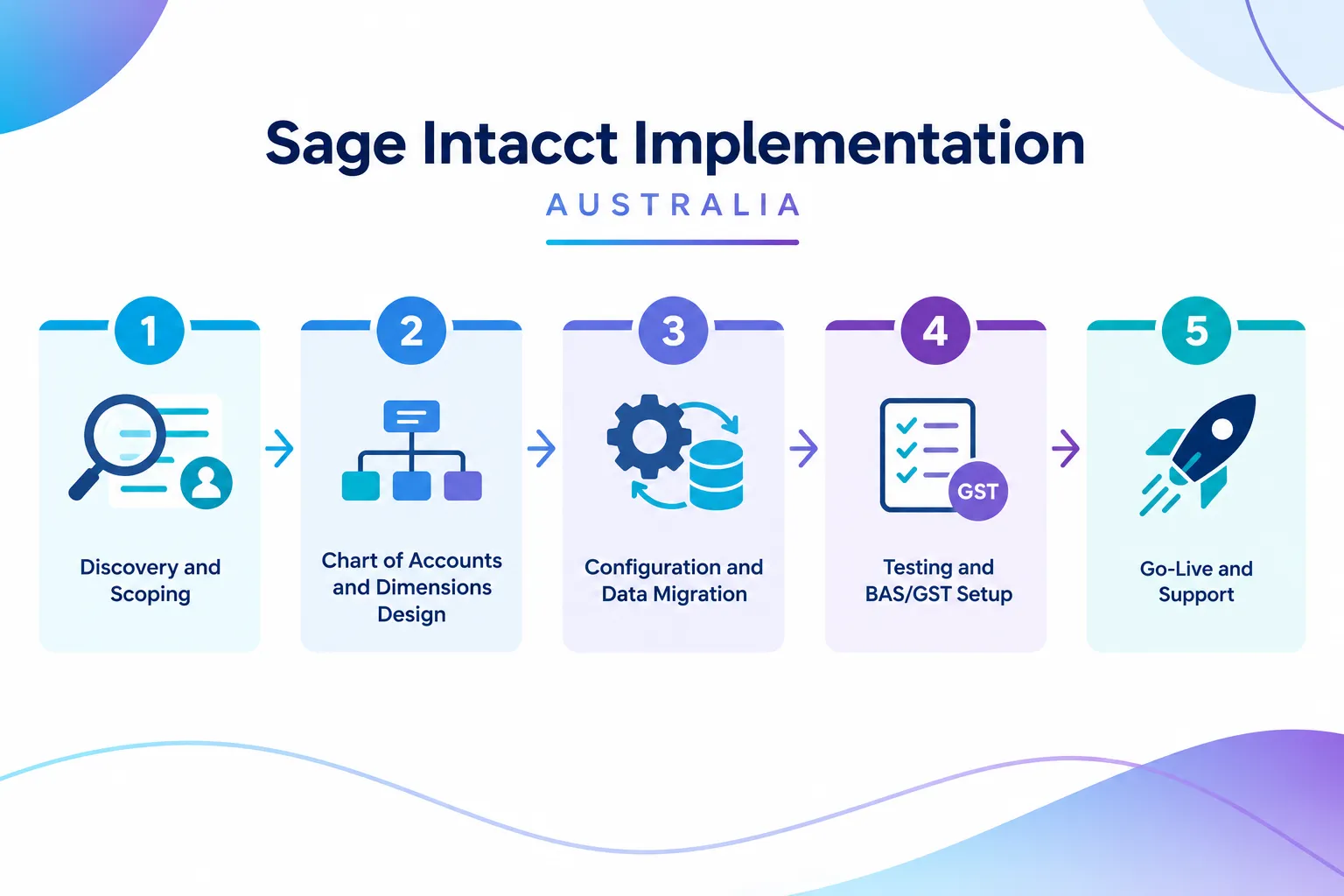
A typical Sage Intacct implementation in Australia follows a structured sequence. Knowing what happens at each stage helps you plan your team’s time and avoid surprises.
Sage Intacct Implementation in Australia: Timeline and Phases
- Discovery and scoping. Your implementation partner reviews current processes, reporting needs and system requirements. This is where decisions about entities, dimensions and modules get made.
- Design and configuration. The chart of accounts, dimension structure, approval workflows and reporting framework are built based on the decisions made during discovery.
- Data migration. Historical data, open balances and master data such as customers, vendors and employees move across from your previous system.
- Testing. Your Finance team tests transactions, reports and workflows before go-live, ideally against real scenarios rather than generic examples.
- Training. Users learn how to work in the new system, with training usually tailored to each role rather than a single generic session for everyone.
- Go-live and early support. The system goes live, usually alongside a support period where the implementation partner helps resolve issues as your team works through its first few processing cycles.
Timeframes vary depending on the number of entities, the complexity of your chart of accounts, and how much historical data needs to move across. A straightforward single-entity implementation will take considerably less time than a multi-entity not-for-profit with program and fund reporting requirements.
What’s New in 2026: Releases, AI and Automation Context for New Projects
Sage releases updates to Sage Intacct three times a year. For organisations starting a Sage Intacct implementation in Australia in late 2026, the current release cycle matters because new projects are typically built on the latest available functionality rather than older configurations.
Recent release cycles have continued to expand automation and reporting capability across the platform, including areas such as close automation, bank feed processing and reporting experiences. Artificial intelligence features, including capabilities under the Sage AI umbrella, have also become a more regular part of release conversations.
If AI or automation functionality is relevant to your organisation, there are three things worth checking with your implementation partner before you assume a feature will be part of your build:
- Is the functionality Generally Available, or is it still in Early Adopter or phased release status?
- Is it confirmed as available in Australia, rather than only in the US, UK or Canada?
- Does it require specific configuration, subscription tier or module to use?
A feature being announced doesn’t automatically mean it’s switched on, available in your region, or included in your implementation scope. Your implementation partner should be able to tell you clearly which functionality applies to your organisation and which doesn’t, rather than assuming everything new is relevant.
How to Prepare for a Sage Intacct Implementation in Australia
Preparation work happens before your project kicks off, and it has more influence on the outcome than most Finance teams expect.

Get your data in order first
Data migration only works well if the data going across is accurate. Before your project starts, review:
- Outstanding customer and vendor balances
- Duplicate or inactive master data records
- Chart of accounts structure, including accounts that are no longer used
- Historical data retention requirements, including how far back you need transaction-level detail versus summary balances
Cleaning this up before migration is far easier than trying to fix it once it’s already in Sage Intacct.
Decide your chart of accounts and dimension structure
This is one of the most important design decisions in any Sage Intacct implementation. Dimensions such as department, location, program, fund or class drive your future reporting. If this structure is wrong, every report built afterwards inherits the same limitation.
Questions worth working through with your team:
- What do we need to report on by entity, department, location, program or fund?
- Which of these should be a dimension rather than a separate account code?
- What reporting do our board, funders or executive team currently ask for, and will this structure support it?
Map your current processes, not just your current system
Don’t assume every existing process should be rebuilt exactly as it is today. Implementation is a good opportunity to ask why a process works the way it does, and whether Sage Intacct functionality could simplify it. Document your key Finance processes, including month-end close steps, approval workflows and reporting cycles, so your implementation partner can see where automation or configuration could reduce manual work.
Plan for training and change management
User adoption after go-live depends heavily on how prepared your team feels. Budget time for training that is specific to each person’s role, not a single generic walkthrough. Identify who in your Finance team will become the internal point of contact for Sage Intacct questions once the project ends, and make sure that person is involved early rather than brought in at the last minute.
Confirm Australian-specific configuration early
Raise BAS, GST, local banking and any industry-specific reporting requirements during the discovery phase, not during testing. This avoids rework and keeps your go-live date realistic.
Choosing an Implementation Partner
Sage is clear that Sage Intacct implementations are delivered through certified partners rather than as a self-service setup. This matters because the platform is highly configurable, and the quality of that configuration depends on the experience of the people doing the work.
When evaluating a partner for your Sage Intacct implementation in Australia, consider:
- Do they have experience with organisations similar in size and structure to yours?
- Do they understand Australian tax, BAS and banking requirements specifically, rather than applying a generic global template?
- Do they have sector experience relevant to you, such as not-for-profit, multi-entity or professional services organisations?
- What does their support look like after go-live, and is that support delivered remotely or in person?
- Will the same people who design the system also be available for support and process improvement afterwards?
Many Australian organisations work with independent Sage Intacct consultants either alongside or instead of a larger partner, particularly for process improvement, reporting and ongoing support once the initial build is complete. Remote Sage Intacct consulting has become a normal way for Australian Finance teams to access this expertise without being limited to partners based in their own city.
Sage Intacct Implementation in Australia for Not-for-Profits and Multi-Entity Organisations
Not-for-profit and multi-entity organisations face additional design decisions during implementation. Reporting often needs to work across entities, departments, programs and funding sources at the same time, which makes dimension design even more important.
Typical considerations include:
- How consolidated reporting across entities should work, including intercompany eliminations
- How program and fund reporting will be structured, and whether this needs to align with funder requirements
- How distributed Finance teams across multiple locations will access and use the system consistently
- Whether approval workflows need to reflect different governance requirements across entities
These requirements aren’t unusual, but they need to be scoped properly at the start. Trying to retrofit multi-entity reporting after go-live is far more disruptive than designing for it during implementation.
What Happens After Go-Live
Go-live isn’t the finish line. It’s the point where your Finance team starts learning how the system actually behaves in day-to-day use.
In the months following implementation, it’s worth reviewing:
- Which reports are being used, and which ones need adjusting now that real data is flowing through
- Whether month-end close is taking longer or shorter than expected, and why
- Where your team is still relying on spreadsheets that could potentially move into Sage Intacct
- Whether additional Sage Intacct training would help close knowledge gaps that have appeared since go-live
Organisations that treat the weeks after go-live as a review period, rather than assuming the job is done, tend to get more value from Sage Intacct sooner.
Frequently Asked Questions
Can we implement Sage Intacct ourselves without a partner? No. Sage Intacct implementations are delivered through certified implementation partners. This reflects how configurable the platform is and the level of expertise needed to set it up correctly for your organisation’s structure and reporting needs.
How long does a Sage Intacct implementation in Australia usually take? This depends on the number of entities, the complexity of your chart of accounts, and your data migration requirements. Single-entity implementations are typically quicker than multi-entity or not-for-profit projects with program and fund reporting.
Do we need to configure BAS and GST separately, or does Sage Intacct handle this automatically? BAS and GST reporting needs to be configured as part of your implementation, based on your organisation’s specific tax codes and reporting obligations. It isn’t something that works correctly without deliberate setup during the project.
Should we wait for a new Sage Intacct release before starting our implementation? Not necessarily. New projects are generally built on whatever release is current at the time, since Sage releases updates several times a year. Your implementation partner can advise whether a specific upcoming feature is worth delaying for, based on your organisation’s needs.
Is Sage AI available as part of a standard Australian implementation? Availability depends on the specific feature, whether it has reached Generally Available status, and whether it is confirmed for the Australian region. Always confirm this directly with your implementation partner rather than assuming a feature announced globally is active in your environment.
What’s the biggest mistake Australian organisations make when preparing for implementation? Underestimating data cleanup and chart of accounts design. Both decisions are harder to fix after go-live than before it, and both have a lasting effect on reporting quality.
Conclusion
A Sage Intacct implementation in Australia works best when it’s treated as a Finance process project, not just a software installation. The organisations that get the most value from the system are the ones that prepare their data, think carefully about their chart of accounts and dimensions, and choose an implementation partner who understands Australian tax, banking and reporting requirements from day one.
If your organisation is preparing for implementation, or you’re already using Sage Intacct and want to check whether your original setup still matches how your Finance team works today, it’s worth reviewing your chart of accounts, reporting structure and month-end processes against what the current version of Sage Intacct can actually do. An independent Sage Intacct consultant can help with that review, whether you’re about to start a project or you implemented years ago and haven’t revisited the setup since.
Meta Title: Sage Intacct Implementation in Australia: What to Expect
Meta Description: A practical guide to Sage Intacct implementation in Australia covering BAS, GST, data prep, partner selection and what to expect at each project stage.
Tags: Sage Intacct implementation, Sage Intacct Australia, Sage Intacct consultant, Sage Intacct consulting, independent Sage Intacct consultant, Sage Intacct training, Sage Intacct support, multi-entity accounting, not-for-profit Finance, Finance systems consultant, Sage Intacct best practices, BAS and GST setup
Contributing writer at Dynamic Zenergy.